Bright Sunrise Montessori Preschool

Programs & Learning
5 Practical Life Skills Montessori Preschools Help Your Child Acquire
Spend a morning in a Montessori classroom, and you’ll notice something missing: worksheets. In their place, a three-year-old buttons a dressing frame. A four-year-old sweeps up crumbs after snack. A five-year-old pours juice for a friend without spilling a drop. None of this is an accident — it’s the curriculum. Educators call it practical life skills in Montessori, and it shapes everything else a child learns.
Montessori teachers build this work around a simple idea: children learn best by doing real things, not pretend ones. Long before letters and numbers take center stage, these everyday tasks teach a child to focus. They teach a child to manage their own body. They also teach a child to become a capable, considerate member of a group.
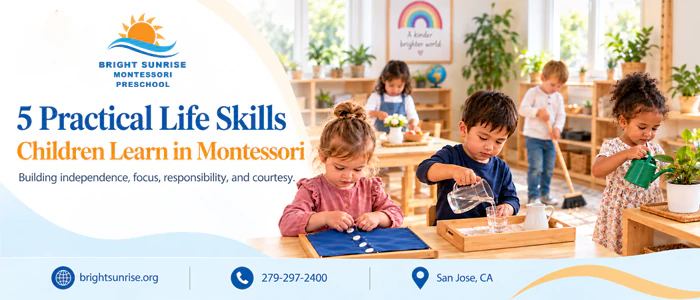
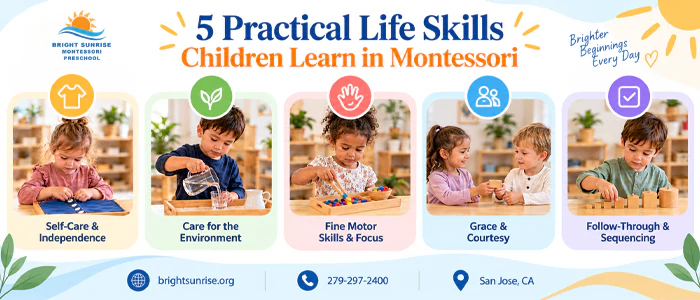
In short, practical life work builds five core skills: self-care and independence, care for the environment, fine motor coordination and focus, grace and courtesy, and the ability to see a task through to the end. Here’s a closer look at each skill, and why it’s worth asking about on your next tour.
Doing Things for Themselves
The dressing frame is a small tool with a big job. It teaches a child to zip, button, snap, or buckle without an adult’s help. Pouring a drink does the same. So does washing hands before lunch, or hanging up a coat.
The classroom doesn’t treat these as chores handed down to a child. Instead, it treats them as milestones the child claims alone. Child-sized tools and low shelves send one clear, constant message: you are capable. That message sticks. The payoff shows up over time: kids who practice self-sufficiency early tend to carry a quiet, earned confidence into everything else they try.
A Classroom That Belongs to Everyone
Watering a plant. Feeding the class fish. Wiping a table. Returning a puzzle to its exact spot on the shelf. None of these tasks is really about tidiness. Instead, they teach a young child that shared spaces need shared effort.
There’s no lecture involved. A child simply notices the plant needs water, or the table is sticky, and does something about it. Over time, that habit of noticing and acting becomes genuine stewardship. First it shows up in the classroom. Later, it shows up at home, with their belongings, and with the people around them.
Small Hands, Serious Focus
Threading beads onto a string. Transferring water from one pitcher to another with a steady hand. Picking up tiny objects with tweezers and sorting them by color. On the surface, these look like fine motor exercises. And they are. But watch a child mid-task, and you’ll notice something else: total concentration.
That’s not an accident. Teachers design every practical life activity to hold a child’s attention from start to finish. That sustained focus later supports handwriting, reading, and math. In other words, the steady hands built today will hold a pencil tomorrow. Bright Sunrise Montessori Preschool sits in San Jose’s Evergreen neighborhood. There, teachers weave this focus-building work directly into the school’s STEAM curriculum. As a result, hands-on concentration and early science, tech, and math exposure grow side by side — not as separate subjects.
Please, Thank You, and Other Habits That Stick
Montessori teachers give grace and courtesy lessons the same intention as anything else on the shelf. How do you greet someone walking into the room? What do you say when you want a friend to move over? And how do you wait your turn without interrupting? These aren’t abstract rules a child hears once. Teachers model them, children practice them, and the classroom repeats them until they simply become how a child behaves.
Because children build this habit early and practice it constantly, good manners never feel imposed from the outside. They feel natural. That’s the real difference between a child taught to be polite and one who simply is.
Seeing a Task Through to the End
Setting a table. Preparing a snack. Completing a multi-step activity in the right order, from start to finish. These tasks share one thing in common. Each one requires a child to hold a sequence in their head, then follow it through. That’s different from jumping to whatever catches their eye next.
This is one of the quieter skills Montessori builds. It may also be one of the most valuable. Planning, sequencing, and following through are the building blocks of executive function. These skills matter just as much in a kindergarten classroom. And they’ll matter years later, too.
What This Looks Like When You're Choosing a Program
Letters, numbers, and colors are easy to check off a list. Independence, focus, responsibility, courtesy, and follow-through are harder to measure. Yet they’re what actually determine how a child settles into a new classroom. These same qualities shape how a child works alongside others and handles a challenge for the first time.
When you’re touring options, ask how practical life shows up day to day. That’s true whether you’re weighing daycare kindergarten preschools in San Jose or simply comparing Montessori programs down the street. It shouldn’t be an occasional activity. It should show up in the daily rhythm of the classroom. Children should genuinely do the tasks themselves, using real tools sized for their hands and guided by teachers trained in the method. At Bright Sunrise Montessori Preschool, this happens across every program level, from the Toddler Program through Pre-Kindergarten. Certified Early Childhood Education teachers guide the process at each stage.
Frequently Asked Questions
At what age do children start practical life activities in Montessori?
Most Montessori programs introduce simple practical life tasks as early as 18 months old. At Bright Sunrise Montessori Preschool, for example, practical life work begins in the Toddler Program (18–24 months). It grows more complex through Early Preschool, Preschool, and Pre-Kindergarten, all the way up to age 5.
Are practical life skills part of kindergarten readiness?
Yes. Independence, focus, following multi-step directions, and social courtesy are core parts of kindergarten readiness. In fact, they often predict a smooth transition better than early academics alone.
Can these skills be practiced at home, too?
Absolutely. Simple tasks reinforce exactly what children practice in a Montessori classroom — think pouring their own water, putting away toys, or helping set the table.
What are practical life skills in Montessori?
Practical life skills are the everyday, hands-on tasks — dressing, pouring, cleaning, greeting others. Montessori classrooms use them to build independence, focus, coordination, and social confidence. They form the foundation of the Montessori curriculum, especially in the toddler and preschool years.
Final Thoughts
Get the practical life foundation right, and the academics tend to take care of themselves. What you’re really giving your child is a head start on independence and self-discipline. That head start lasts well beyond their preschool years. That’s a strong reason to make practical life skills a key question on your list. It applies whether you’re evaluating Montessori programs, daycare, kindergarten, or preschools in San Jose.
Ready to see practical life in action? Schedule a tour at Bright Sunrise Montessori Preschool. Watch firsthand how every part of your child’s day builds independence, focus, and confidence.