Bright Sunrise Montessori Preschool

Parent Guides
Digital Play vs. Hands-On Play: Finding the Right Balance for Preschoolers
Tablets, learning apps and talking toys are everywhere, and many parents wonder whether screen time helps or holds back a three- or four-year-old. That is the heart of the digital play vs hands-on play question every parent of a young child faces today. The short answer: young children learn best through their hands, their senses and real relationships, and digital play works best as a small, guided extra rather than the main event. Here is what experts recommend, how to find a healthy balance at home, and how a Montessori preschool in San Jose, CA puts it into practice.
What Is the Difference Between Digital Play and Hands-On Play?
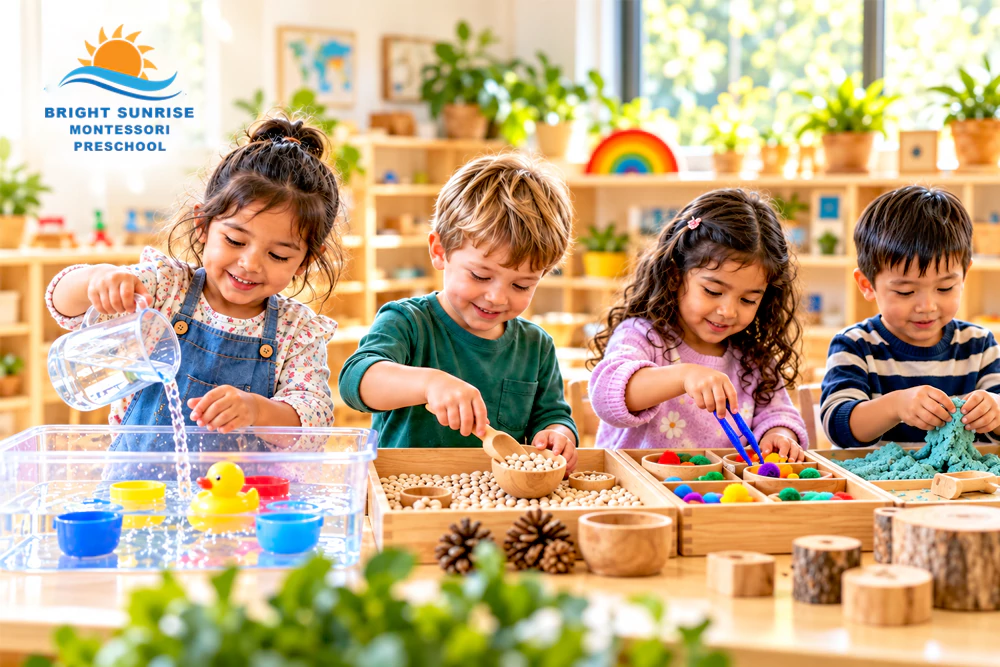
Digital play is any play that happens on a screen: learning apps, games, videos, and interactive e-books. Hands-on play uses real objects and the whole body: building with blocks, pouring water, sorting beads, digging in the garden, painting or pretend cooking.
Both can hold a child’s attention. However, the difference is how much of the child is involved. For example, a screen mostly engages the eyes and one fingertip. In contrast, hands-on play engages touch, movement, balance, problem-solving and, very often, conversation with another person.
Digital Play vs. Hands-On Play at a Glance
| What your child develops | Digital play | Hands-on play |
|---|---|---|
| Fine motor skills | Tapping and swiping | Pinching, pouring, threading, building |
| Senses used | Mostly sight and sound | Touch, sight, sound, smell and movement |
| Problem-solving | Follows the app's set answers | Open-ended trial and error |
| Social skills | Usually played alone | Sharing, turn-taking, conversation |
| Attention span | Quick rewards can shorten focus | Real tasks build patience |
| Creativity | Limited to the app's options | Endless and child-led |
| Best role in the day | Short, high-quality, watched together | Most of the day |
Why Hands-On Play Matters So Much in the Preschool Years
Between ages two and five, a child’s brain builds connections faster than at almost any other time,physical experience drives much of that growth. Hands-on play supports:
Fine motor skills. Pinching, twisting and threading strengthen the small hand muscles children later need to hold a pencil.
Real problem-solving. When a block tower falls, a child learns about weight and balance in a way no animation can teach.
Language and social skills. Building together and pretend play mean talking, sharing and taking turns.
Focus and patience. Real tasks have no reward sounds, so children learn to stay with a challenge until they finish it.
Sensory development. Textures, temperatures and weights help children make sense of the world around them.
Does Digital Play Have Any Benefits?
Yes, when parents choose it carefully. For instance, high-quality programs can introduce letters, numbers and new words, and video calls help children stay close to grandparents and family who live far away.
In other words, what matters is quality, quantity and company. The American Academy of Pediatrics suggests limiting screen use for children ages 2 to 5 to about one hour a day of high-quality content, ideally watched with an adult who talks about it with the child. The World Health Organization gives similar advice for 3- and 4-year-olds: no more than one hour of sedentary screen time a day, and less is better.
Ultimately, the real concern is not the device itself but what it replaces. After all, every hour on a screen is an hour not spent moving, building, talking or sleeping.
How to Find the Right Balance at Home
- Make hands-on play the default. Keep blocks, play dough, art supplies and safe kitchen tools within easy reach.
- Set clear screen routines. Decide when and where your child uses screens, and keep them away from bedtime and meals.
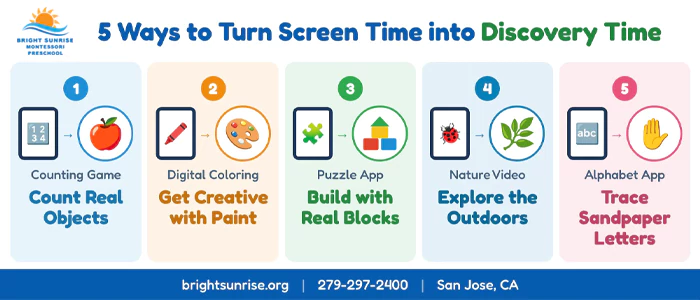
- Watch together and talk. Connect what your child sees to real life: “You saw a caterpillar. Let’s look for one in the garden.”
- Choose calm, simple content. In particular, skip apps full of flashing rewards and autoplay.
- Turn screen ideas into real activities. If your child loves a counting app, count spoons, stairs or oranges together.
- Model the habit. Above all, children notice when adults put their phones away.
How Montessori Education Supports Hands-On Learning
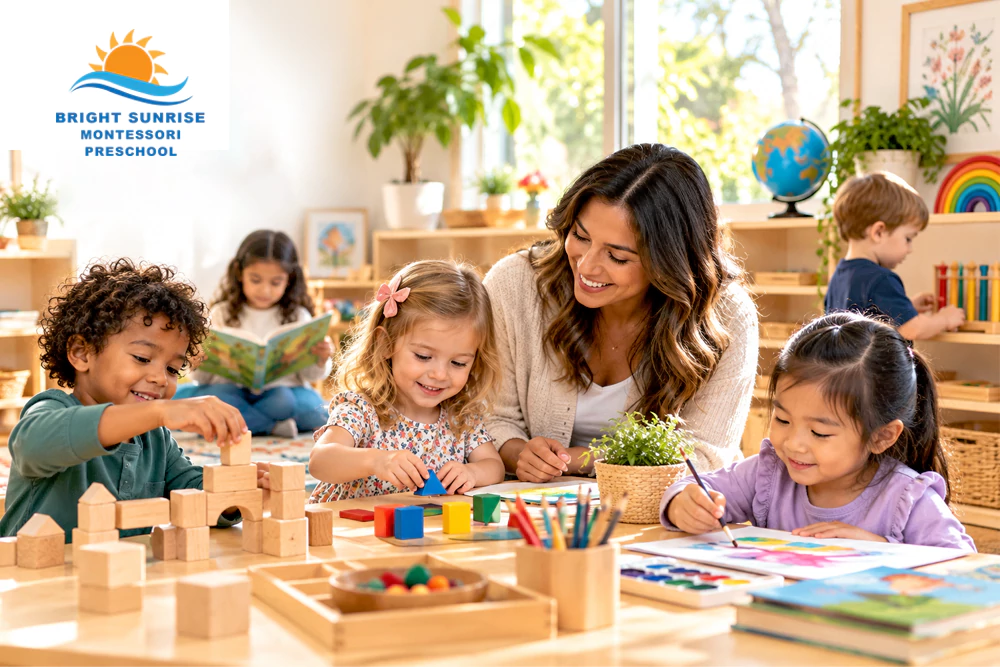
The Montessori approach rests on the idea that children learn through their hands. Classrooms use carefully designed, self-correcting materials, such as sandpaper letters, number rods and practical life work like pouring, buttoning and food preparation, so children explore ideas physically before meeting them in abstract form.
Walk into a Montessori classroom and you might see a moment like this: a three-year-old at the pouring tray spills a little water. Instead of an adult rushing in, she reaches for the small sponge kept nearby, wipes the table and tries again, a little slower this time. No app awarded her a gold star, yet in one quiet minute she practised hand control, concentration and independence.
At Bright Sunrise Montessori Preschool, we build our Montessori classrooms around this hands-on philosophy. Across our programs for ages 18 months to 5 years, children choose purposeful work, move freely and learn alongside their peers with gentle guidance from trained teachers. As a result, children build the concentration, independence and curiosity that serve them well beyond preschool. For families looking for a Preschools in Evergreen San Jose, that puts real-world learning first, our Evergreen campus offers a calm, child-centered environment filled with meaningful discovery every day.
Frequently Asked Questions
How much screen time is okay for a preschooler?
About one hour a day or less of high-quality content, ideally watched with a parent or caregiver.
Is hands-on play better than educational apps?
For most early learning goals, yes. Apps can reinforce ideas, but children build deeper understanding, motor skills and social skills through real materials and real people.
Visit Our Preschool in San Jose
Looking for a preschool in San Jose, CA where hands-on learning comes first? Schedule a tour of Bright Sunrise Montessori Preschool at 3520 San Felipe Rd, San Jose, or call us at 279-297-2400. We would love to show your family around.