Bright Sunrise Montessori Preschool
Parent Guides
Is Pre-K Different Than Daycare? A Guide for San Jose Parents
Pre-K vs. Daycare: Are They Really Different?
Yes. Daycare mainly focuses on safe, caring supervision while you work, while a pre-K program follows a structured curriculum that prepares your child for kindergarten. Many families use the words interchangeably, and some centers offer both, which is why the choice can feel confusing.
If you are searching for a pre-K program in San Jose or comparing daycare in San Jose, understanding this difference helps you pick the setting that fits your child’s age, your schedule, and your goals. In this guide, we break down what each option offers, what children learn, and what to ask when you visit centers in Evergreen and nearby neighborhoods.
What Is Daycare?
Daycare is child care for working families. It typically serves infants, toddlers, and preschoolers, and it usually runs for long hours, often covering the full workday. If you are looking for daycare near me in San Jose, this is what most centers provide.
A good daycare offers:
- A safe, nurturing space with attentive caregivers
- Regular meals, snacks, naps, and diaper or potty routines
- Free play, story time, music, and outdoor time
- Flexible full-day or extended-hour schedules
- Care for a wide age range, often from infancy
Many quality daycares also include early learning activities. The key difference is that the day is built around care and routine first, and formal school readiness is not always the main goal.
What Is a Pre-K Program?
Pre-K is an early education program, usually for children around 4 to 5 years old, designed to prepare them for kindergarten. The day follows a planned curriculum with clear learning goals, led by teachers trained in early childhood education.
A strong pre-K program in San Jose typically includes:
- Early literacy: letter recognition, phonics, and story comprehension
- Early math: counting, patterns, shapes, and problem solving
- Science and hands-on discovery
- Social and emotional skills like sharing, listening, and managing feelings
- Fine motor practice such as writing, cutting, and drawing
- A predictable daily structure that mirrors a classroom
Pre-K vs. Daycare: Key Differences
The biggest differences come down to purpose, structure, and who teaches your child.
| Feature | Daycare | Pre-K Program |
|---|---|---|
| Main purpose | Safe, reliable care while parents work | Kindergarten readiness and early learning |
| Typical age | Infants to preschoolers | About 4 to 5 years |
| Daily structure | Flexible routines, play, meals, naps | Planned lessons and learning blocks |
| Curriculum | Often informal or play-based | Structured, goal-driven curriculum |
| Teacher focus | Caregiving and supervision | Early childhood education and instruction |
| Hours | Long, often full-day | Set class hours, with extended care at some centers |
| Progress tracking | Daily notes or updates | Skill assessments and progress reports |
Tip: many San Jose centers combine both, offering a pre-K curriculum inside a full-day schedule. Always ask how much of the day is structured learning.
What Do Pre-K Children Learn That Daycare May Not Cover?
Children in daycare still learn through play, songs, and social time. A pre-K classroom adds intentional, sequenced teaching so skills build week by week.
- Early reading and writing. Children learn letter sounds, rhyming, and how to hold a pencil, and they begin writing their names.
- Early math. Counting to 20 and beyond, comparing sizes, sorting, and simple patterns become part of daily activities.
- Classroom readiness. Sitting for circle time, following multi-step directions, raising a hand, and taking turns are practiced daily, so kindergarten feels familiar.
- Critical thinking and curiosity. Guided projects, questions, and simple experiments encourage children to explain their ideas.
- Social and emotional growth. Teachers help children name feelings, resolve conflicts, and build confidence and independence.
Most parents want their child to feel ready and excited for kindergarten. That is exactly what a well-planned pre-K program is built to deliver.
Which Is Right for Your Child?
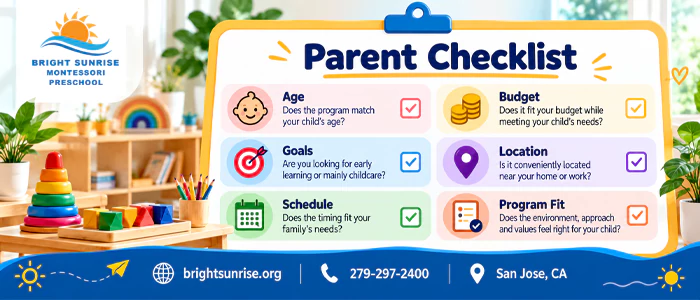
The right choice depends on four things.
- Age. Children under 3 are usually best served by daycare with nurturing caregivers. Around age 3 to 4, a pre-K program becomes a strong fit.
- Goals. If kindergarten readiness is a priority, choose a program with a defined curriculum and progress tracking.
- Schedule. Working parents may need full-day hours. Look for a center that offers structured pre-K learning within a full-day schedule.
- Budget. Compare what is included, such as meals, enrichment, and extended hours, rather than only the monthly rate.
For many families, the best answer is not one or the other. A center that offers both daycare and pre-K lets your child grow in one familiar place, with no disruptive switch between programs.
How to Choose the Best Pre-K in Evergreen, San Jose
Whether you are searching for the best pre-K in Evergreen San Jose or the right daycare in Evergreen San Jose, visit in person and use this checklist.
- Licensing and safety: Is the center licensed? Are entrances secure, and are staff trained in first aid and CPR?
- Teacher qualifications: Do lead teachers have early childhood education training? How long have they been on staff?
- Curriculum: Can they show you a daily schedule and explain what children learn each week?
- Ratios and class size: How many children does each teacher supervise?
- Learning environment: Are classrooms clean, bright, and full of books, art, and hands-on materials?
- Communication: How do teachers share progress, and how often do they meet with parents?
- Location and hours: Is the center convenient to your home or commute, with hours that fit your work schedule?
Questions to ask on your tour:
- How do you prepare children for kindergarten?
- What does a typical day look like?
- How do you handle separation anxiety and new-child transitions?
- Do you offer both daycare and pre-K options?
Frequently Asked Questions
Is pre-K different than daycare?
Yes. Daycare focuses on care and supervision for a wide age range, while pre-K follows a structured curriculum that prepares 4 to 5 year olds for kindergarten.
At what age should my child start pre-K?
Most children begin pre-K around age 4, though some programs accept 3-year-olds who are ready for a structured setting.
Can a child attend daycare and pre-K at the same place?
Yes. Many centers offer full-day care with a pre-K curriculum built in, so working parents get both learning and flexible hours.
Is pre-K worth it if my child already attends daycare?
If your daycare does not follow a structured curriculum, pre-K can help build reading, math, and social skills that make the move to kindergarten smoother.
How do I find daycare near me in San Jose?
Search for licensed centers near your home or work, read parent reviews, schedule tours, and compare curriculum, teacher experience, and hours.
What should I look for in a pre-K program in San Jose?
Look for qualified teachers, a clear curriculum, low child-to-teacher ratios, a safe and engaging environment, and regular communication with parents.
Find the Right Fit for Your Child in San Jose
Daycare gives your child a safe, caring place to spend the day, and pre-K gives them a head start on learning. The best choice is the one that matches your child’s age, your family’s schedule, and your goals for kindergarten.
Looking for a pre-K program in San Jose or daycare in Evergreen? Visit Bright Sunrise Montessori Preschool, serving children from 18 months to 5 years, to see our classrooms, meet our teachers, and learn how we combine caring full-day childcare with a strong pre-K curriculum.
Contact Us to Schedule a Tour or call us at 279-297-2400 to reserve your child’s spot.